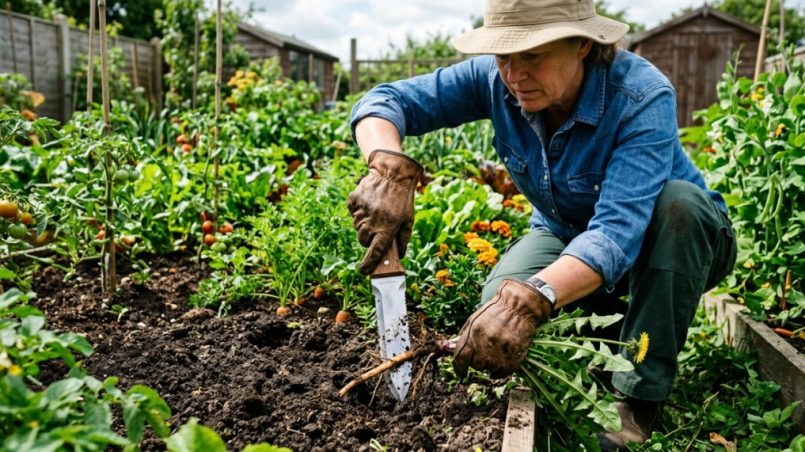
Is there anything more frustrating than spending a beautiful Saturday morning on your knees, only to have your weeding tool snap in half on the first stubborn dandelion? You brace, you pull, and suddenly you are holding a broken handle while the root stays firmly lodged in the soil. This scenario is all too common for gardeners who grab the cheapest tool on the rack. The truth is, weeding is a battle of leverage and persistence, and your equipment needs to be tougher than the terrain. To win this battle, you need a durable weeding knife for gardens that feels like an extension of your arm, built to withstand years of prying, cutting, and slicing through compacted earth.
Selecting that perfect tool isn’t just about picking the shiniest blade. It involves understanding steel grades, handle ergonomics, and blade geometry. Many gardeners overlook the fact that a weeding knife, often called a hori-hori or soil knife, is arguably the most versatile tool in the shed next to the shovel. Whether you are dealing with taproots, grassy weeds, or cracks in the patio, the right knife saves hours of labor. In this comprehensive guide, we will dissect every component that contributes to longevity and performance, ensuring that your next purchase is your last purchase for a very long time.
What Defines a Durable Weeding Knife for Gardens?
A durable weeding knife for gardens is defined by its material composition, construction method, and the ergonomic integrity of its handle. Unlike flimsy trowels, a true weeding knife is designed specifically for slicing through soil and cutting roots. Durability comes from high-carbon stainless steel that resists rust while maintaining a sharp edge, and a full-tang handle that extends through the grip. If a knife bends under pressure or the handle wiggles, it is not durable, regardless of the marketing claims.
Understanding Steel Grades and Blade Composition
The blade is the soul of the tool. You will typically see two primary categories: stainless steel and carbon steel. For a durable weeding knife for gardens, Japanese stainless steel (often SK-5 or AUS-8) offers a perfect balance of edge retention and corrosion resistance. Cheaper tools use low-grade 3Cr13 steel, which chips easily. When shopping, look for “high-carbon” stamped on the blade. This indicates that the steel has enough carbon to be hardened to a level that holds a sharp edge during heavy root cutting. Additionally, a thicker blade (2.5mm to 3mm) resists bending when you are using leverage against a rock.
The Importance of Full-Tang Construction
A full-tang design means the metal of the blade runs entirely through the handle. This is non-negotiable for durability. Many cheaper knives use a “rat-tail” tang or a simple plug that is inserted into the handle. Under heavy stress, these joints fail. With a full-tang knife, there is no weakest point; the force transfers directly from your wrist to the tip of the blade. If you cannot see the metal running the full length of the handle, be skeptical. This single factor is often the difference between a tool that lasts three years and one that lasts thirty.
Why Is Blade Thickness and Shape Critical for Longevity?
Blade thickness dictates how much force the knife can withstand before snapping. The shape dictates how effectively you can target different weed types. A durable weeding knife for gardens typically features a blade thickness of 2mm to 3mm. Thin blades are agile but brittle; thick blades are tougher but can be clumsy for precise cutting. The shape also matters: a straight edge is perfect for slicing, while a curved edge (like a hori-hori) is better for scooping and prying.
Straight Edge vs. Curved Edge: Which Lasts Longer?
In terms of pure mechanical durability, a curved edge is often favored. The curve provides a “belly” that distributes stress across a wider area when prying. Straight edges concentrate stress at the heel of the blade, which can lead to micro-fractures over time. However, for cutting through dense root mats, a serrated edge on one side and a straight edge on the other offers the best of both worlds. The serrations act as a saw, reducing the amount of pressure required, which in turn protects the blade from bending, Looking for the perfect pair of shoes for your next big event? Check out our guide on Wedding Shoes That Match Any Formal Outfit for stylish ideas that complement any look.
Where to Look for Weak Points in the Blade
Inspect the transition area where the blade meets the handle. This is called the “shoulder.” A sharp 90-degree angle here is a stress riser and a common breakage point. Look for a gradual, rounded transition instead. Also, examine the tip. A pointed tip is essential for piercing hard soil, but it should not be too delicate. A reinforced tip with a slight drop-point design is less likely to snap off when you accidentally hit a buried stone.
How Does Handle Material Affect Durability and Grip?
The handle is your point of contact, and it must survive impacts, moisture, and friction. A durable weeding knife for gardens features handles made from either kiln-dried hardwood (like Ash or Walnut) or high-grade thermoplastics (like TPR or Nylon). Wood offers a classic feel but requires maintenance. Plastic is more forgiving, but you must avoid hollow plastic handles which break easily. The handle must also have a secure grip to prevent blisters, as fatigue leads to careless mistakes that damage the tool.
Wooden Handles: Pros and Cons for Longevity
Wooden handles, particularly Ash wood, are incredibly shock-absorbent. They flex slightly with impact, reducing stress on the tang. However, they are susceptible to water damage and cracking if left in the rain. To ensure durability with wood, check that it is treated with a sealant or oil. A “pinned” wooden handle (where a metal pin goes through the wood and the tang) is vastly superior to a glued handle. This pin provides a mechanical lock that resists the twisting forces of weeding.
Rubberized and Plastic Handles: Are They Worth It?
Modern rubberized grips (like TPR) provide excellent traction, even when wet. They are generally more durable against moisture than wood. Yet, you must be wary of “overmolded” plastic handles that lack a solid core. If the handle is flexible plastic over a thin tang, it will eventually become loose. For maximum lifespan, look for a handle that is bolted or mechanically fastened to the tang, not just glued. The best rubber handles are also resistant to UV degradation, which prevents them from becoming brittle in the sun.
Which Materials Resist Rust and Corrosion Best?
Regarding rust resistance, high-chromium stainless steel is the clear winner. However, “stainless” does not mean “stain-proof.” Ferritic stainless steels (like 440A) offer excellent corrosion resistance but may not hold an edge as long as martensitic steels (like 440C). A coating, such as a titanium nitride or a black oxide finish, adds another layer of protection. For gardening, you often expose tools to acidic soil and water, so you need a balance. A durable weeding knife for gardens should have a protective coating or a high-grade stainless composition to prevent pitting.
Carbon Steel vs. Stainless Steel: A Long-Term Comparison
Carbon steel (like 1095) can be sharpened to a razor edge and holds it incredibly well, but it rusts quickly if you so much as look at it wrong. Stainless steel (like SK-5) is more forgiving. For a practical, long-term tool, high-carbon stainless steel is the “best of both worlds.” It contains enough carbon (around 0.75%) to allow hardening, but enough chromium (around 13%) to prevent immediate rust. If you opt for pure carbon steel, be prepared to oil the blade frequently and never leave it dirty.
The Role of Protective Coatings in Durability
Coatings are not just for aesthetics. A powder coat or a ceramic coating protects the blade from acidic sap and soil moisture. However, some coatings are too thick and dull the cutting edge. The most durable option is a “stonewashed” finish, which hides scratches and resists corrosion. If you intend to leave your knife in the garden shed without meticulous cleaning, a coated blade is essential for preventing corrosion.
How to Test a Knife’s Durability Before You Buy
You cannot test a knife in a sealed package at the store, but you can perform a few “torture tests” at home once you purchase it. First, attempt to bend the knife by placing it on a hard surface and applying weight to the handle. It should flex slightly and return to shape. If it bends easily and stays bent, it is too soft. Second, try to scrape a metal file across the edge; it should “bite” into the file, indicating high hardness. Third, check the handle for any “play” or movement. Any wiggle is a sign of future failure.
A Quick 3-Step Stress Test for Home Evaluation
To evaluate your new tool, first, place the blade on a block of wood and push down on the handle with 20 lbs of force. Second, use the tip to pry apart two pieces of plywood. Third, leave it in a bucket of moist soil for 48 hours and then inspect for rust. If the knife passes all three without damage or excessive corrosion, you have found a genuinely durable weeding knife for gardens. These tests simulate the worst-case scenario of rocky, wet soil.
Reading Reviews for Longevity Indicators
When researching online, do not look at the overall star rating; look at the 3-star and 4-star reviews. People who leave negative reviews often cite specific failure points, such as “handle broke after 3 months” or “tip chipped.” If you see a pattern of the same failure, avoid it. Look for reviews specifically mentioning “years of use.” A tool that survives five years of abuse in a drought-prone, rocky region is a good candidate.
Can a Serrated Edge Improve the Knife’s Lifespan?
Yes, a serrated section can improve lifespan by reducing the brute force needed to cut through fibrous roots. When you use a serrated edge, you are sawing, which requires less downward pressure than chopping. This reduced pressure means less stress on the tip and the tang. Many professional landscapers prefer a knife with a straight edge for the top 60% and a serrated edge near the handle for sawing through tough material.
When Does a Serrated Edge Become a Weakness?
Serrations can be a weakness if they are overly aggressive and deep. Deep serrations create thin “teeth” that can snap off when hitting rocks. Look for “shallow” serrations that are more like a wavy edge. Also, sharpening a serrated edge requires a special round file, which is fine for maintenance but annoying if you live far from a hardware store. For pure root cutting in rich soil, a straight edge is often enough.
Combination Blades: The Ideal Compromise
The most durable configuration is a combination blade: 70% straight edge for slicing and 30% serrated near the heel for sawing. This design allows you to use the straight edge for delicate work and the serrations for tough vines without ever forcing the tip. This reduces the risk of bending the tip. Brands like Hori-Hori often use this design, and it significantly increases the tool’s versatility and lifespan.
How Does Handle Length Impact Control and Durability?
Handle length affects leverage. A standard weeding knife has a handle of 4 to 5 inches. A longer handle (6 inches) provides more leverage for prying, but it also increases the bending moment on the blade. If you have a long handle with a thin blade, you are more likely to snap it. For maximum durability, match the handle length to the blade thickness. A thick blade (3mm) can handle a longer handle; a thin blade (2mm) should have a shorter handle to avoid excessive torque.
Short Handles: Best for Precision and Leverage Control
Short handles (4-5 inches) allow you to get your hand close to the soil, providing precise control. This is ideal for weed identification and working in tight flower beds. In terms of durability, the short handle reduces the force applied to the blade because you are restricted to using your wrist and elbow, not your full shoulder. This prevents accidental over-forcing that leads to breakage.
Long Handles: When Extra Reach Causes Risk
Long handles (6+ inches) let you use two hands for extra prying power. While this is great for stubborn roots, it is dangerous for the blade. If you use a long handle on a hard-packed clay soil and lean into it, you can easily snap the tip. If you prefer long handles, ensure the blade is exceptionally thick (3.5mm). This is a trade-off: reach versus robustness.
What Is the Ideal Balance and Weight for a Weeding Knife?
The ideal weight is between 8 to 12 ounces. This weight provides enough mass to drive the blade into soil without being exhausting. The balance is equally important; the tool should feel “head-heavy,” meaning the blade is slightly heavier than the handle. This helps the knife do the work with gravity, rather than requiring you to push. A well-balanced knife reduces fatigue, which prevents sloppy technique that can damage the tool.
Why Heavier Knives Often Last Longer
Heavier knives are usually made with thicker steel. A 10-ounce knife often has a 3mm thick blade, whereas a 6-ounce knife might be 1.5mm. The thicker steel provides a higher structural limit. However, a knife that is too heavy (over 14 ounces) becomes cumbersome. The “sweet spot” for durability and usability is around 9-11 ounces. If you find a knife in that weight range, it is likely constructed with enough material to survive serious work.
The Impact of the Handle Shape on Grip Strength
The profile of the handle plays a role in your grip. An “ergonomic” shape with a contoured finger groove helps you maintain a firm grip without excessive squeezing. A slippery, round handle forces you to grip tighter, increasing muscle fatigue. Tight grip and fatigue lead to tremors, which can cause you to jerk the tool and snap the blade. Look for a handle with a waist or a slight pommel at the end to prevent your hand from sliding up onto the blade.
How to Maintain Your Weeding Knife for Maximum Durability
Even the best knife will rust or dull if neglected. To ensure your durable weeding knife for gardens lasts a lifetime, you must clean it after every use. Wipe the blade with a dry cloth to remove soil and sap. If you have a carbon steel blade, apply a light coat of mineral oil. For stainless steel, a quick wipe is often enough, but you should still avoid letting it sit wet in a shed.
Sharpening Techniques That Preserve the Blade
Use a diamond file or an whetstone to maintain the edge. Do not use a bench grinder; the heat generated can ruin the temper of the steel, making it soft. To sharpen, hold the blade at a 15-degree angle and pass the file from the base to the tip in a sweeping motion. Do this 5-10 times before each gardening session. This “micro-maintenance” prevents dullness that forces you to push harder, which is a leading cause of blade damage.
Storage Solutions That Prevent Rust and Damage
Never store your knife in a leather sheath if it is wet. Leather holds moisture against the steel, promoting rust. Instead, use a plastic or Kydex sheath that allows air circulation. Alternatively, hang the knife on a wall in a dry environment. If you store it in a tool bag, wrap it in a dry cloth. Adding silica gel packets to your tool bag can also absorb excess humidity.
Can You Sharpen a Dull Weeding Knife Easily?
Yes, you can sharpen a weeding knife easily if it is made of straight or serrated steel. You need a diamond rod and about 5 minutes. The ease of sharpening depends on the steel’s hardness. If the steel is too hard (HRC 60+), it is difficult to sharpen. If it is too soft, it dulls quickly. The ideal hardness is HRC 55-58, which is sharp enough to cut roots but tough enough to resist chipping.
Tools You Need for Sharpening at Home
Invest in a coarse diamond file (400 grit) for reshaping and a fine ceramic rod (1000 grit) for finishing. For serrated edges, you need a conical diamond file. Do not use sandpaper; it is too slow and inconsistent. A bench vice to hold the knife is also helpful, but you can sharpen by hand if you are careful to maintain a consistent angle. Always sharpen towards the edge, not away from it.
Signs That Your Blade Needs Immediate Sharpening
If you notice the knife is “bouncing” off the soil instead of slicing through, it is dull. If you have to use excessive force to cut a dandelion stem, it needs sharpening. Visually, you will see a shiny line along the edge; this is the “rolled” metal. Sharpen it before it becomes so dull that you have to push so hard you risk bending the blade. Dull tools are more dangerous to the user and the tool itself.
Is a Stainless Steel Knife Always the Most Durable?
Not always. While stainless steel resists rust, it is often more brittle than carbon steel. Some low-grade stainless is soft and dents easily. A high-carbon steel knife that is properly hardened can hold an edge longer and resist bending. There is a trade-off: carbon steel requires maintenance to prevent rust. The “most durable” is a high-carbon stainless steel alloy that offers the benefits of both.
Comparing Hardness Ratings (HRC) for Garden Knives
A durable weeding knife for gardens should have a hardness rating between 55 and 60 HRC on the Rockwell scale. Below 55, the edge rolls over easily. Above 60, the edge is brittle and can chip when it hits a stone. Japanese knives often rate at 58-60 HRC. American knives are usually softer at 55-56. For garden use, 57-58 is the optimal range. Check the manufacturer’s spec sheet; if they don’t list a rating, they likely have not hardened the steel properly.
The Myth of “Unbreakable” Garden Knives
There is no unbreakable knife. A knife can be snapped if you use it as a pry bar against a boulder. The goal is to find a knife that breaks only under extreme, intentional abuse. Beware of brands that advertise “unbreakable” – often they are using soft, thick steel that bends but cannot hold an edge. A knife that bends is arguably worse than one that snaps because it is useless when bent. Seek balance, not absolutes.
Which Type of Weeding Knife Is Best for Different Soil Types?
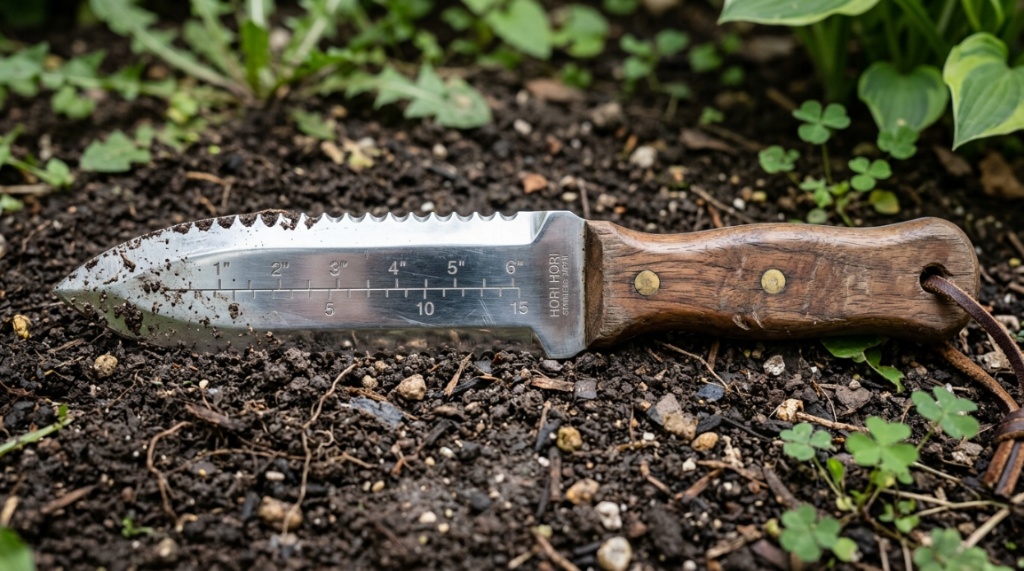
The soil in your garden dictates which knife is best. In sandy, loose soil, a lighter knife with a thinner blade works fine. In clay or rocky soil, you need a heavy-duty, thick blade with a tough tip. For dry, hardened soil, you need a knife that can act as a chisel. Understanding your soil prevents you from buying a tool that is either underpowered or unnecessarily heavy.
Knives for Hard Clay and Rocky Terrain
For clay soil, choose a knife with a very strong tip and a thick spine (3mm). The blade should have a slight curve to act as a “hook” to pull out roots. A straight, flat blade will get stuck in the sticky clay. Look for a knife with a textured, non-slip handle because clay makes everything slippery. A polished blade is easier to pull out of clay than a matte finish.
Knives for Soft Sandy Soil and Raised Beds
In sandy soil, a thinner blade (1.5mm – 2mm) is easier to push into the ground. You don’t need extreme thickness because there is little resistance. A straight edge is fine for slicing through loose weeds. A lightweight knife (6-7 ounces) reduces wrist strain during long sessions. However, ensure the steel is still high-grade to prevent sand from scratching and dulling the edge.
When Should You Replace Your Weeding Knife?
Replace your weeding knife when the blade is worn down to half its original width, the tip has snapped off, or the handle has become loose. A knife that is chipped severely can be ground down, but eventually, you are losing too much material. If the blade is bent, it must be replaced; bending weakens the steel structure even if you bend it back. Similarly, if the handle splits or cracks, do not try to glue it; replace the tool.
Signs of Metal Fatigue and Stress Fractures
Inspect the blade for hairline cracks, especially near the tang. Use a magnifying glass if needed. If you see a crack, the knife will eventually break at that point. Metal fatigue also shows as a “gray” or discolored area. If the blade has developed a permanent bend, you have exceeded the yield strength of the steel. Stop using it immediately. Continuing to use a fatigued knife is dangerous as it may shatter unexpectedly.
Recycling or Repurposing Old Garden Knives
You can repurpose an old knife as a dedicated paint scraper, a fertilizer measuring scoop, or a chisel for cutting sod edges. Do not throw them in the trash if they are stainless steel—check your local recycling program. If the handle is wood and the blade is steel, you can remove the handle and use the tang as a marking tool. Recycling is eco-friendly and gives the tool a second life.
Frequently Asked Questions
What is the best steel for a garden weeding knife?
High-carbon stainless steel (like SK-5 or VG-10) is best for garden weeding knives. It offers a good balance of edge retention, toughness, and rust resistance. Avoid basic stainless steel (like 3Cr13) as it is too soft for heavy root cutting.
How often should I sharpen my weeding knife?
You should sharpen your weeding knife every 2 to 3 uses, depending on soil conditions. If you hit sandy soil, sharpen more often. A quick touch-up with a diamond file before each session keeps the edge perfect and reduces the effort needed to cut.
Can I use a weeding knife to dig bulbs or plant seeds?
Yes, a weeding knife is versatile. Use the pointed tip to dibble holes for bulbs and seeds. Use the flat side of the blade to create furrows. This makes it a multi-purpose tool, which is why it’s so popular among professional gardeners.
Are serrated weeding knives better than straight edges?
Serrated knives are better for cutting through fibrous roots and thick vines, as they act like a saw. Straight edges are better for clean cuts and precise slicing. Many durable models feature both: a straight edge for most work and a serrated section near the handle.
How do I remove rust from my weeding knife?
Use a fine steel wool or a rust eraser to gently scrub the rust off. Apply a thin coat of mineral oil to the blade after cleaning. For stubborn rust, soak the blade in white vinegar overnight, then scrub and oil it. Avoid leaving the knife wet afterward.
Is a titanium coated weeding knife worth the extra cost?
Titanium nitride coatings are highly durable and reduce friction, allowing the blade to slide through soil easier. They also prevent corrosion. However, the coating is only as good as the underlying steel. If the steel is good, the coating is a bonus; if the steel is poor, the coating won’t save it.
What length should my weeding knife be?
The total length should be between 10 and 12 inches, with a blade length of 6 to 7 inches. This provides enough reach to cut roots at depth without being unwieldy. Handle length should be 4 to 5 inches for comfortable control.
Selecting a durable weeding knife is an investment in your back and your time. By focusing on steel hardness, tang construction, and blade geometry, you can avoid the frustration of flimsy tools. Look for high-carbon stainless steel with a full tang and a comfortable grip. Match the tool to your soil type, and maintain it with regular cleaning and sharpening. This approach ensures your knife lasts for decades, making weeding a satisfying task rather than a battle. A good weeding knife is not just a tool; it is a companion in the garden. So, take your time, feel the balance, and choose wisely. Your garden will thank you for it.
